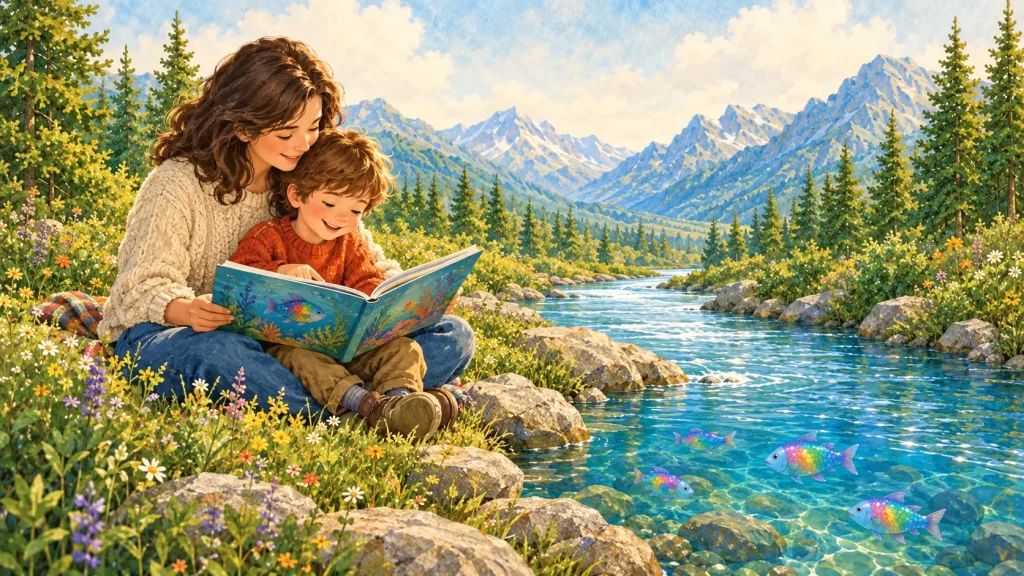
There are a lot of things children remember from when they’re little. Some of them are big things. First days of school. Birthday parties. Trips. Holidays. But sometimes, it’s the really ordinary moments that stick around too. Sitting next to a parent at bedtime.
Picking a favorite book from the shelf. Laughing at the same part of a story for the tenth time. Asking, “What happens next?” Those little moments might not seem like much at the time, but they can become some of the memories children carry with them.
That’s one of the reasons I love children’s books. A book gives a parent and child a reason to slow down for a few minutes and just be together. No phones.
No rushing around. No trying to get through a hundred things at once. Just a story. And maybe a few questions along the way. That’s part of what I had in mind when creating Danny and the Rainbow Fish.
Danny’s story is colorful and playful, but it also gives families a few different things they can talk about together.
Why did Danny put the food in the river? Was he trying to hurt the fish? What would you have done? Why did Oliver want to change his color? Is it okay to be different?
Those questions don’t have to turn into some serious conversation. Sometimes a child will have a funny answer and move on to the next page. That’s okay. The conversation itself is valuable. Children are constantly trying to make sense of the world around them. They ask questions because they’re curious, and stories give them a safe way to explore those questions.
A character can make a mistake without the child having to make that exact mistake themselves. A character can feel left out.
A character can be nervous. A character can discover something new. And sometimes a child sees a little bit of themselves in that character. That’s one of the things I like about Danny. He’s curious.
He gets excited. He makes a mistake. And then he has to figure out what to do about it. That’s a pretty normal part of growing up. Another reason reading together can be special is language. For families who speak more than one language, reading can become an even more meaningful experience.
Danny and the Rainbow Fish is written in both English and Spanish because I wanted families to have the option of enjoying the story in either language or moving between both.
Maybe English is the language a child is most comfortable with. Maybe Spanish is spoken more often at home. Maybe the family uses both every day.
There doesn’t have to be a perfect way to do it. A parent might read a page in English and then read it again in Spanish. A child might recognize a Spanish word they haven’t heard before. Someone might stop and ask what a word means. And suddenly, reading the book has become more than just reading.
It’s talking. It’s learning. It’s spending time together. And sometimes it’s laughing because somebody decides one of the fish looks particularly funny. That’s the part that matters.
Children don’t need every experience to be turned into a lesson. They need time. They need attention. They need chances to ask questions without feeling like every answer has to be correct. And they need stories.
A children’s book can create that space in a way that feels natural. You can read a story at bedtime. You can read it during a quiet afternoon. You can take it to the library. You can read it with a classroom. Or you can read the same book so many times that you start remembering the words before the child does.
Parents know that one.
“Again.”
And somehow, it’s always again. But there is something pretty wonderful about that too. The first time through, a child might just be interested in the colorful fish. The second time, they might notice Oliver. The next time, they might ask why the river became dirty.
A few readings later, they may remember that Danny cleaned everything up. Children notice different things at different times. That’s another reason I don’t think a story has to explain everything. Sometimes it’s better to leave a little room for the child to think. Danny and the Rainbow Fish was created with that in mind. I wanted it to be fun enough that children would actually want to come back to it, but I also wanted there to be something underneath the colorful pictures and the silly moments.
Something parents could talk about with their children. Friendship. Being yourself. Making mistakes. Taking responsibility. Caring about nature. And simply being curious about the world. Those are all pretty big ideas, but they don’t have to feel big when they’re inside a story.
Maybe that’s one of the best things about children’s books. They can take a complicated idea and make it simple enough to talk about while sitting on the couch together. And sometimes, that’s all you need.
A few pages. A little imagination. A curious child. And someone willing to read the story one more time. Because years from now, the child may not remember every word from the book. They may not remember exactly what happened on every page. But they might remember sitting beside someone they loved, listening to a story, laughing at the colorful fish, and asking what happened next. To me, that’s a pretty good reason to keep telling stories.