Sometimes a children’s book is just a fun story. And that’s perfectly fine. Kids should be able to open a book, see a bunch of colorful fish, laugh at something silly, and wonder what happens next without feeling like they’re sitting through a lesson. But every once in a while, a story can do both. It can be fun and still leave you thinking about something after you’ve closed the book.
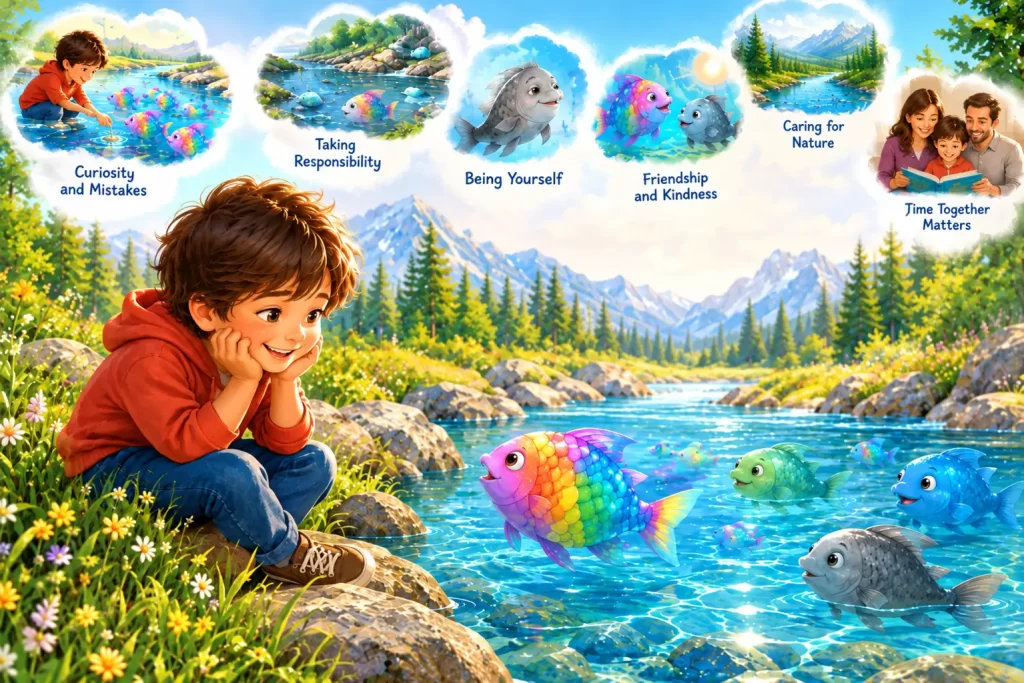
That’s what I hope happens with Danny and the Rainbow Fish. At first, Danny’s adventure seems pretty simple. He’s spending time by the river with his parents when something unexpected happens. A fish eats his pink bubble gum and, somehow, turns pink.
Naturally, Danny is fascinated.
He wants to see it again. So he starts giving the fish different foods, and soon the river is filled with fish in all kinds of colors. It’s exciting.
It’s also a little chaotic.
And that’s where things begin to change. Danny doesn’t realize that what he’s doing is hurting the fish. He’s not trying to cause trouble. He isn’t thinking about damaging the river or making the fish sick.
He’s just having fun. That’s actually one of the reasons I think children can connect with Danny. Most children aren’t waking up in the morning thinking about making bad choices. They’re curious. They experiment. They see something interesting and want to know more.
Sometimes that curiosity gets them into trouble. Danny’s mistake gives children a chance to see something that we all have to learn eventually: good intentions don’t always mean good results.
You can mean well and still make a mistake. What matters is what you do once you understand what happened. Danny eventually realizes that the river isn’t okay. The water has become dirty, the fish are sick, and the things he threw into the river have become part of the problem.
So he helps clean it up. That part is just as important as the mistake itself. I didn’t want Danny to be a perfect character. Perfect characters aren’t very interesting anyway. He makes a mistake.
He learns. Then he tries to fix it. I think that’s a much more useful lesson for children. Another part of the story I really like is Oliver. Oliver doesn’t like being gray. He thinks being colorful would make him more special, and for a while, it seems like he’s right.
Who wouldn’t want to be a bright green fish swimming around in a beautiful river?
But eventually, the colors are gone. Oliver is gray again. And he’s okay. He’s still Oliver. That’s a simple idea, but I think it’s an important one. Children are surrounded by messages about how they’re supposed to look, act, dress, and fit in. Even when they’re very young, they notice differences.
So I wanted Oliver’s story to quietly remind them that being different isn’t something they need to fix.
You don’t have to be the brightest person in the room. You don’t have to look like everyone else. You don’t have to change yourself just because someone else thinks you should. There is value in being yourself. And then there’s friendship. Danny’s relationship with the fish is part of what makes the story work. He doesn’t just see them as colorful things to look at. He starts to care about them. When he realizes they’re being hurt, he does something about it. That’s what friendship can look like.
It’s not always about having fun together. Sometimes it’s noticing when someone isn’t okay. Sometimes it’s helping. Sometimes it’s admitting that you did something wrong. Those aren’t always easy things, even for adults. For children, they’re lessons worth introducing early. The river itself is another important part of the story.
Nature can sometimes feel like something that’s just there. A river is a river. A park is a park. A lake is a lake. But those places are homes for animals and plants, too. When Danny throws things into the river, he’s not just making the water messy. He’s affecting a place where other living things depend on being safe.
I wanted that idea to be simple enough for a child to understand without making it heavy. You don’t have to do something huge to take care of the environment. Sometimes it starts with something as basic as not throwing trash on the ground. Or picking something up when you see it.
Or understanding that the choices we make can affect someone—or something—else. That’s also why the English and Spanish format of Danny and the Rainbow Fish is important. Stories have a way of bringing people together, and I wanted families who speak English, Spanish, or both to have that opportunity with this book.
Maybe a parent reads one part in English and another in Spanish. Maybe siblings help each other with words. Maybe the story gets read at bedtime and becomes one of those books a child keeps asking for again and again.
Those little moments are meaningful. Because at the end of the day, that’s really what I want this book to be. A story children enjoy. A story families can share. A story that gives everyone something to talk about without making it feel like homework. Maybe a child remembers the rainbow-colored fish. Maybe they remember Danny cleaning the river.
Maybe they remember that Oliver was perfectly happy being gray. Or maybe they just remember that they had a good time listening to the story. Any of those things are okay with me. If Danny and the Rainbow Fish can make a child laugh, spark a question, or start a conversation between a parent and child, then I think the story has done something worthwhile. And if it reminds someone that being yourself matters, that mistakes can be fixed, and that the world around us deserves a little care too… Well, that’s even better.