I actually came up with this story in highschool. I was in AP Spanish and we were told to write a short story in Spanish. I had two pairs of twins in my class which is how I came up with the idea for brother fish who looked different. (I got an A for my story). I’ve always been creative, so the story came to me quickly. I randomly thought about it again as an adult, adjusted a few things and rewrote it in English and Spanish and was ready to share it with the world and my daughter.
Every story has to start somewhere. Sometimes you have the whole idea figured out from the beginning. Other times, you have one little thought and you’re not even sure where it’s going to lead.
That’s kind of how I think about Danny and the Rainbow Fish. It started with a simple idea about a boy, a river, and some fish that suddenly start changing colors. It was fun, a little silly, and honestly, the kind of thing I could imagine a child getting excited about.
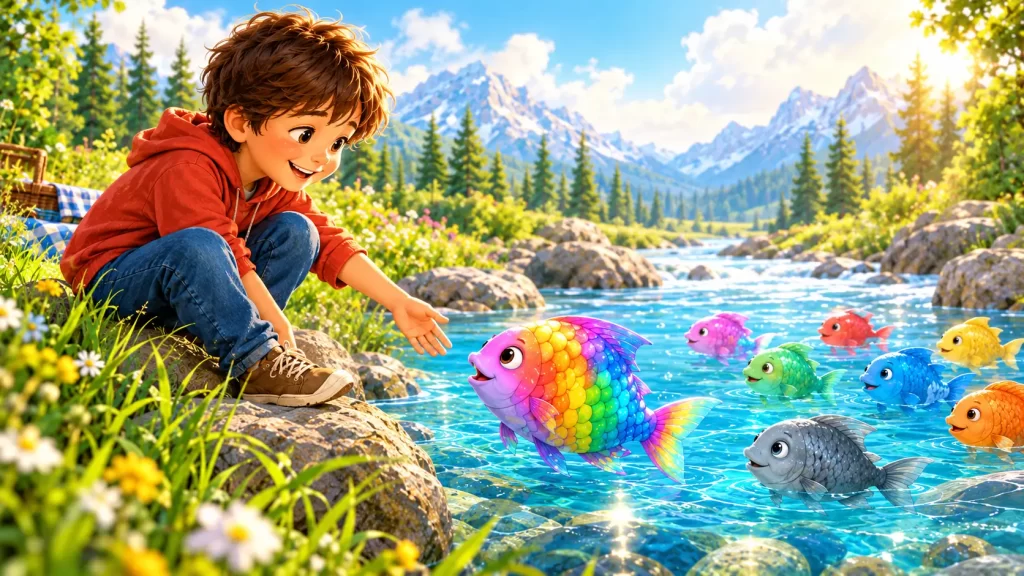
And then the story started becoming something more. Danny is having a normal day with his parents. They’re spending time by the river, enjoying a picnic, and everything seems pretty ordinary. Then Danny accidentally drops his pink bubble gum into the water.
A fish eats it. And somehow, that fish turns pink. Danny is amazed. And really, who wouldn’t be?
If I watched a fish eat bubble gum and suddenly turn pink, I’d probably want to know if it could happen again too. So Danny starts trying different foods. One fish turns green. Another turns red. Then there are yellow, blue, orange, purple, and pink fish swimming around the river.
To Danny, it’s exciting. It’s colorful. It’s fun. But, as usually happens in stories, there’s a problem that Danny doesn’t see coming.
The food he’s throwing into the river doesn’t belong there. What seems like a harmless little game starts affecting the fish and their home. The water becomes dirty and cloudy. The fish aren’t feeling well. And suddenly, Danny realizes that what he thought was just fun has actually caused some damage.
I think that’s an important part of Danny’s story. Kids are curious. They’re going to try things. They’re going to ask, “What happens if I do this?” Sometimes they’ll make a mess. Sometimes they’ll make a mistake without even realizing it was a mistake. That’s how children learn.
And honestly, adults do the same thing sometimes. The important part isn’t never making a mistake. It’s what you do once you realize something went wrong. Danny doesn’t run away from the problem. He doesn’t pretend it wasn’t his fault. He takes responsibility.
He helps clean the river and picks up the things he threw into the water. He tries to make things right. That’s something I wanted children to see in the story. Making a mistake doesn’t automatically make you a bad person. You can mess up, learn from it, and still do something good afterward.
Danny also learns something about friendship. One of the fish he meets is Oliver. Oliver is tired of being gray and thinks being colorful would be much better. At first, he really likes the idea of having bright green scales.
And who can blame him? Being different can be exciting. But eventually, the colors disappear, and Oliver is gray again. Danny is surprised. But Oliver isn’t upset. He feels better. He’s still Oliver. And Danny realizes that Oliver didn’t need a different color to be special.
That message is a big reason I wanted to tell this story. Children notice differences. They notice what people look like, what they wear, what they can do, and what makes someone different from everyone else.
I think it’s important for them to learn early that different isn’t bad. You don’t have to look a certain way to be special. You don’t have to change yourself to fit in. And being a good friend has very little to do with what’s on the outside. Sometimes it’s about being kind. Sometimes it’s about listening. Sometimes it’s simply being there.
Danny and the Rainbow Fish is also bilingual, written in both English and Spanish. That part matters to me because I wanted families who speak either language, or both, to be able to enjoy the story together.
Maybe a parent reads it in English and then reads it again in Spanish. Maybe a child knows one language better than the other. Maybe the family goes back and forth between both. There really isn’t one right way to do it. The main thing is that they’re reading together.
And hopefully talking, laughing, asking questions, and maybe arguing over which fish is the coolest. Kids will probably have their own opinions about that.
At the end of the day, I didn’t want Danny and the Rainbow Fish to feel like a lesson disguised as a book. I wanted it to be a story first.
Something colorful. Something fun. Something children would actually want to hear again.
But if they finish the story and start thinking about friendship, taking care of nature, or what it means to make a mistake and fix it, then that’s pretty special too.
Maybe they’ll ask why Danny shouldn’t have put food in the river. Maybe they’ll talk about why Oliver is okay with being gray. Maybe they’ll ask what they would have done if they were Danny.
Those conversations are part of the fun. Because sometimes a children’s story doesn’t need to have a huge complicated message. Sometimes it just needs to remind us of a few simple things. Take care of your friends.
Take care of the world around you. It’s okay to make mistakes. And you don’t have to change who you are to be special. And, of course, sometimes the brightest colors aren’t the ones you can see.